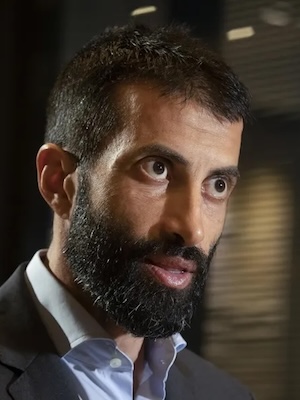
Mosab Hassan Youssef
Mosab Hassan Yousef is a Palestinian-born author and former spy, widely known as the "Son of Hamas." Born in 1978 in Ramallah, he is the eldest son of Sheikh Hassan Yousef, a founding member of the militant organization Hamas. During the late 1990s and early 2000s, Yousef worked as a double agent for Israel’s internal security service, the Shin Bet, under the codename "The Green Prince."
His decision to defect was sparked by witnessing Hamas's internal brutality and torture of its own members while he was imprisoned in the mid-90s. For nearly a decade, Yousef provided critical intelligence that thwarted dozens of suicide bombings and assassination attempts, effectively saving hundreds of lives on both sides. In 2007, he moved to the United States, where he was granted political asylum in 2010. He famously converted to Christianity—though in recent years he has shifted toward a more philosophical, non-religious worldview—and authored the bestselling autobiography Son of Hamas. Today, he is a prominent, often polarizing public speaker and critic of Islamist ideology, frequently appearing on international news platforms to discuss Middle Eastern security.
What critics say
Critics, particularly within Palestinian and Muslim communities, often label Yousef a "traitor" for his collaboration with Israeli intelligence and for disowning his family's legacy. He is frequently accused of Islamophobia due to his inflammatory rhetoric, such as comparing Islam to Nazism and stating he has "zero respect" for those who identify as Muslim. Some human rights advocates and students argue his speeches incite hatred and promote a "narrative of victimhood" that delegitimizes Palestinian national identity. Additionally, some skeptics question the authenticity of his shifting religious and political stances for public attention.
Why we follow
him
Many follow Yousef for his unparalleled insider perspective on the inner workings of Hamas, a viewpoint few others can provide. Supporters admire his moral courage in risking his life to prevent violence and his willingness to challenge the ideology he was groomed to lead. He is seen as a "truth-teller" who exposes the complexities of the Middle East conflict beyond standard political narratives. For his followers, he represents the possibility of individual transformation—moving from a life of radicalization to one of advocating for peace, security, and the protection of innocent lives.