The Right Time, The Right Place
With the major misconceptions (the first article) cleared, you are now about to discover the basics of Islam. If up until now the topic seemed complex and contradictory and therefore daunting, now is the time and the place to start learning. Now is the time, because sooner rather than later, if not already, Islam will impact your life. And this is the place, because here you will find exactly what you should know about the history of Islam, its principal actors and some important definitions. You will discover how the teachings of Islam, through its trilogy of sacred texts inform the worldview of Muslims and impact your life. Crucially, you will gain understanding how Muslims, not knowing any better, and not allowed to think any different, navigate the cognitive dissonance posed by the contradictions of their faith. We will not teach you how to be a good Muslim, so to find out more about the five pillars and the six articles of faith, we recommend the Quran itself and the hadiths. Read on to grow your confidence in your knowledge and opinions.
We distinguish five general aspects to Islam (not to be confused with the five pillars which we don't cover):
- Trilogy: all of Islam is based upon the trilogy, the Quran, the Sīrah (Muhammad’s biography) and the Hadiths (his traditions). All of these texts stem from one man only. No divine miracles, and certainly no substantiating witnesses to them. When the texts of these three sources are sorted and analyzed, the remaining four aspects emerge to complete the foundation of Islam.
- Politics: Islam is heavy on rules and obedience. A good Muslim is one obedient to the prophet. And a significant part of the Islamic doctrine is political, not religious.
- Kaffirs: Islam divides the world into Muslims and kafirs, non-Muslims and devotes a large part of its teachings (e.g. 18% of the Quranic verses) passing instructions on how to deal with them.
- Dualism: Political Islam always has two different ways to treat kafirs (dualistic ethics)
Kafirs can be abused in the worst ways, or they can be treated like a good neighbor. - Submission: Kafirs must submit to Islam in all politics and public life. Every aspect of kaffir civilization must submit to political Islam.
This information alone already equips you to ask the right questions in conversation, and it arms you with the framework for processing whatever new information you might find.
While these five descriptions may sound prejudiced, we assure you they are not. However, we'll let the religion speak for itself.

You’ve been told Islam is a peaceful religion. A spiritual path. A brotherhood/sisterhood of believers seeking a higher connection. You’ve been told it’s like Christianity, just with different prayers and a different book.
You are wrong.
The Great Deception of the Divine
Islam is not a private meditation practice. It is not a loose collection of ethical guidelines. It is a totalitarian legal and moral system. It is an ideology of governance that dictates every facet of a believer’s life—war, commerce, sexuality, and thought. To a Muslim, the Quran is not a suggestion; it is the literal word of God. The Hadith are not traditions; they are binding precedent. And "Sharia" is not a metaphor for religious law; it is an active, enforceable code.
If you intend to live, work, or even simply speak to a Muslim in the modern world, you must understand this distinction. Ignorance of Islam’s comprehensive nature is not a theological minor sin; it is a practical liability.
Why "Understanding Islam" Matters Now
In the West, we often treat religion as a personal matter: "My God," "Your God." We fail to recognize that for Muslims, Christianity, Judaism, and indeed all other faiths, are viewed through a specific theological lens defined by their scripture.
If you are a Christian engaging with a Muslim, you are discussing doctrines that the Quran explicitly addresses. You will be questioned regarding the nature of Jesus, the Trinity, and the authority of the Bible. If you enter that conversation unprepared, you are not being disrespectful; you are being exploited.
Muslim preachers are master manipulators of cultural anxiety. They thrive on the ignorance of the uninformed. They will take a positive social truth—such as the importance of women’s rights, or the value of scientific accuracy—and retroactively attach it to Islam as if the religion were the originator of that idea.
- Tactic 1: "Muhammad was a feminist!"
- Tactic 2: "The Quran predicted modern science!"
- Tactic 3: "Islam is the only true path to liberation from oppression!"
When the average Christian walks into a debate armed only with their own Bible and their own faith, they become easy targets. The Muslim preacher, however, speaks the language of the oppressor the Christian perceives to be the victim. If you do not know the historical reality behind these claims, you cannot refute them.
The Dangerous Atavism of Slavery
A prime example of how historical ignorance fuels modern misinformation is the narrative surrounding Islam and slavery.
In the 1960s, the Black Power movement embraced Islam—not just Sunni Islam, but often even elements of the Nation of Islam—as a weapon against white supremacy. The message was clear: "Christianity is the religion of the white man. It enslaved your people. Islam liberates."
This message only worked because of a profound historical gap in the West’s understanding of the religion. Most white Americans in the 1960s did not realize that:
- The Hadith collections (the sayings and actions of Muhammad) had only recently begun to be systematically translated into English.
- Muhammad himself was a slave owner who participated in the lucrative African slave trade.
To the modern historian, it is absurd that the man who founded a religion preaching liberty would be the central figure in financing the very systems that enslaved millions. Yet, without that contextual knowledge, the narrative of "Islamic liberation" spread like wildfire.
This is the cost of theological laziness. If you want to correct a misunderstanding about Islam, you must first know whatthe misunderstanding is based on and what the actual history is.
Conclusion: An Ideology, Not Just a Religion
Do not approach Islam as you would a neighbor’s Sunday service. It is not a cultural phenomenon for many Muslims; it is their entire framework for reality.
To understand Islam is not to become a scholar. It is to stop viewing it as a monolithic, peaceful "other." It is to recognize a complex, legally binding system designed to convert adherents into active participants in a global governance structure. In a world where Muslims hold significant political and social sway, this basic awareness is no longer a luxury—it is a necessity for informed citizenship.
The next time a Muslim preacher steps into your community, armed with a script you don't recognize, you will be better prepared if you have read these tenets first.
An exploration of the internal mechanics of Islamic theology, illustrating how the faith functions primarily as a rebuttal to the Judeo-Christian tradition it seeks to supersede, and by consequence, as a systematic dismantling of the assurance of grace.
1. Introduction
Ornately adorned holy books. The mysterious allure of veiled women. The pious song of the call to prayer. Islam often presents itself in a dazzling light, with proponents weaving a captivating narrative that highlights its perceived virtues and benevolence. They expertly quote select passages and extol the merits of Islamic justice, banking systems, and moral codes—positioning the faith as the perfect antidote to Western civilization's perceived ills.
But why does Islam exist? What substance lies beneath this polished exterior? Dig deeper, and a stark reality emerges: Islam is fundamentally—even obsessively—a counter-movement against Judaism and Christianity, despite claiming otherwise. It functions as a 'corrective' to what its adherents perceive as flaws in these faiths. The Quran itself reflects this: hundreds of verses focus on Jews and Christians, exposing a primary driving force behind the religion’s theology. The following article examines these foundations, arguing that the religion’s historical expansion has relied less on voluntary conversion than on conquest and demographic shifts.
2. What Islam Teaches about God
At first glance, the Islamic conception of Allah—as All-Powerful (2:10), All-Knowing (24:21), and Merciful (11:45)—bears a striking resemblance to the Biblical Yahweh. This is no accident. During his twelve years in Mecca, Muhammad positioned himself as the successor to the biblical prophets, convinced that the Jewish tribes of Medina would recognize him from their own scriptures (7:157). However, when he arrived in Medina, the Jewish community rejected his claims, leading to a sharp theological pivot.
Islam’s "Allah" eventually emerged as a solitary monad defined by what he is not:
- Not a Trinity: The Quranic critique of the Trinity (5:116-117) is curiously misinformed, seemingly defining the Triune God as a triad consisting of Allah, Jesus, and Mary. This presents a theological dilemma: either the deity is ignorant of the doctrine he critiques, or the text is a human misunderstanding of 7th-century heterodoxies.
- Father to No One: In Islam, the Fatherhood of God is strictly forbidden (19:88-93). While the Bible presents a relationship of adoption, the Quran insists that no one approaches Allah except as a 'abd' (slave).
- Conditional Love: Unlike the New Testament command to love one's enemies to reflect the Father’s nature, Allah’s love is transactional. He explicitly does not love the unbeliever (3:32), the proud, or the "mischief-makers."
3. What Islam Teaches about Jesus
The Quranic Jesus (Isa) is a figure of immense power yet stripped of His redemptive purpose. He is born of a virgin (3:47), performs unparalleled miracles—such as breathing life into clay birds and raising the dead (3:49)—and is called the "Word of Allah" (4:171) and even the "Messiah" (although most Muslims may not be able to explain what that means,).
Yet, these titles are hollowed out. Muhammad adopted the terminology of Christians without inheriting the theology. While Jesus is the only sinless person inIslamic tradition—untouched by Satan at birth—the Quran vehemently denies His divinity (9:30) and His death. Following Gnostic-like theories, the Quran claims Jesus was not crucified but was taken up alive (4:157-158). By removing the Cross, Islam removes the very heart of the Christian faith, leaving a "Messiah" who did not save and a "Word" that remains silent on the nature of God.
4. What Islam Teaches about Christians
The Islamic view of Christians (Nasara) is a study in chronological volatility. Early passages describe Christians as "nearest in friendship" (5:82) and full of compassion (57:27). However, as Muhammad’s political power grew and Christian rejection became clear, the rhetoric hardened.
The "People of the Book" were reclassified:
- Unbelievers: Those who believe in the Deity of Christ are labeled kafir (unbelievers) and described as the "worst of creatures" (98:6).
- Subjugation: The final dictates of the Quran command Muslims to fight and subjugate Jews and Christians until they pay the jizya (tribute) as a sign of their inferior status (9:29). While spared the "convert or die" mandate given to polytheists, Christians are relegated to a permanent underclass.
5. What Islam Teaches about the Quran
TheQuran is presented as the uncreated, perfect word of Allah, protected from corruption (15:9) and possessing "unsurpassable literary excellence" (2:23). It is the ultimate "corrective" to the supposedly corrupted Bible. Adherents are taught that the book is free from contradiction (4:82), serving as the final authority for all human conduct.
6. What Islam Teaches about Muhammad
Muhammad is heralded as the "Seal of the Prophets" (33:40), the final messenger sent to provide the Arabs—and subsequently the world—with a revelation in their own tongue. He is the "perfect pattern of conduct" (33:21), making his personal life and decisions the absolute moral standard for all Muslims. This status necessitates the belief that His coming was foretold in the Torah and the Gospel, despite the lack of such evidence in the biblical record.
7. Common Muslim Objections to Christianity
Muslim apologetics typically rely on a small rotation of standardized objections. They are designed to undermine the reliability of the Gospel:
- Scriptural Corruption: The claim that the Bible has been altered (tahrif) to hide prophecies of Muhammad.
- The Incomprehensibility of the Trinity: Arguing that 1+1+1 cannot equal 1.
- The Demand for a Specific Verse: Challenging Christians to find a verbatim quote where Jesus says, "I am God, worship me."
- The Impossibility of God Dying: A refusal to accept the dual nature (Incarnation) of Christ.
- The Moral Objection to Substitution: Claiming it is unjust for God to punish one for the sins of another—an objection that ironically collapses when confronted with Hadiths (e.g., Sahih Muslim 37:6665) stating that Allah will punish Jews and Christians in Hell as a "ransom" for the sins of Muslims.
8. Common Muslim Arguments for Islam
When moving from defense to offense, Islamic proponents often cite the following, though each faces significant historical and logical hurdles:
- Literary Excellence: The claim that the Quran is so beautiful it must be divine. This is subjective; critics like Antony Flew noted that reading the Quran can feel like "doing penance" due to its disorganized and repetitive nature.
- Perfect Preservation: The narrative of "one Quran, not a letter changed" was shattered by the discovery of numerous varying Arabic manuscripts and historical records of lost verses—some allegedly eaten by a sheep (Sunan Ibn Majah 1944).
- Scientific Accuracy: Modern claims that the Quran contains advanced science are contradicted by its own text, which describes the sun setting in a muddy pool (18:86) and stars as missiles used to pelt demons (67:5).
- Rapid Growth: Often cited as proof of truth, this growth is actually driven by high birth rates in Muslim-majority countries rather than a global wave of voluntary conversions.
9. Closing: The Great Divergence
The fundamental raison d'être of Islam is the rejection of the Christian Gospel. Where Christianity offers salvation as a free gift of grace through the finished work of a sacrificial Savior, Islam offers a return to a system of "good works" and legalism.
In Islam, the "burden-bearer" must carry his own weight, yet remains in a state of perpetual uncertainty, hoping his submission to the Five Pillars is enough to satisfy a master-slave relationship. The tragedy of Islamic theology is that it acknowledges Jesus as sinless and the "Word," yet strips Him of the very cross that would allow Him to bear the burdens of the slaves who cry out to Allah. Ultimately, Islam stands not as a continuation of the biblical narrative, but as a systematic dismantling of the assurance of grace.

The Quran isn’t one coherent book—it’s a patchwork of revelations delivered piecemeal over 23 years, later rearranged thematically rather than chronologically, with a built-in doctrinal override system called naskh (abrogation). Later verses can replace or cancel earlier ones. This structure explains much of the text’s internal tensions and its adaptability.
Revelation and Compilation
According to Islamic tradition, the Quran was revealed to Muhammad in fragments—short passages during the Meccan period (610–622 CE) and longer, more legislative ones after the Hijra to Medina (622–632 CE). These were memorized by companions and written on whatever materials were available: palm leaves, bones, stones, and parchment.
The standard text today follows the Uthmanic recension, compiled around 650 CE under Caliph Uthman, roughly 18–20 years after Muhammad’s death. Uthman standardized one version and ordered others destroyed to eliminate variant readings. No complete manuscripts from Muhammad’s lifetime survive in the exact modern form. Early fragments like the Sana’a palimpsest show textual variants, corrections, and erasures—challenging claims of perfect, verbatim preservation from the moment of revelation.
The 114 surahs (chapters) are not in chronological order of revelation. They are arranged roughly from longest to shortest (except Surah 1). This non-chronological compilation is why the text can feel disjointed to new readers.
Meccan vs. Medinan: Two Distinct Phases
Islamic scholarship divides the surahs into Meccan (revealed while Muhammad was weaker, outnumbered) and Medinan (revealed after he gained political and military power in Medina).
- Early Meccan surahs (e.g., 96, 53, 112): Short, poetic, focused on monotheism, warnings of judgment, and calls to worship. They often sound tolerant or defensive: “To you your religion, and to me mine” (109:6) or “no compulsion in religion” (2:256).
- Later Medinan surahs (e.g., 2, 5, 8, 9): Longer, legalistic, and commanding. They address warfare, governance, taxation (jizya), inheritance, marriage, and relations with non-Muslims. Examples include the Sword Verse (9:5) and “Fight those who do not believe...” (9:29).
This shift is not subtle. Classical scholars and chronological lists (such as those used by Nöldeke or traditional Muslim sources) place the more militant verses in the Medinan period.
Abrogation (Naskh): The Override System
The Quran itself authorizes later revelations to supersede earlier ones:
“We do not abrogate a verse or cause it to be forgotten except that We bring forth [one] better than it or similar to it. Do you not know that Allah is over all things competent?”
Quran 2:106
Classical scholars like al-Tabari, Ibn Kathir, and al-Suyuti developed extensive lists of abrogated verses—sometimes numbering in the hundreds. *Naskh* typically applies to legal rulings (*hukm*), not the text itself (the verse often remains in the book, but its application is cancelled).
Key examples:
- Wine: Starts with mild disapproval (2:219), moves to restrictions during prayer (4:43), and ends with full prohibition (5:90–91).
- Fighting: Early tolerance (“no compulsion,” 2:256) gives way to commands to fight polytheists (9:5) and People of the Book until they pay jizya in submission (9:29).
- Prayer direction (qibla): Initially toward Jerusalem, later changed to Mecca.
- Inheritance and other laws: Multiple adjustments across revelations.
Scholars decide which verses abrogate which, based on chronology and context. This human adjudication layer sits atop a text claimed to be the eternal, uncreated word of Allah.
Why This Matters
Abrogation undermines several common claims:
- “Perfect, unchanging text”: If meanings shift with circumstances, the idea of a single, timeless miracle is weakened. Apologists often quote abrogated Meccan verses to Western audiences while orthodox jurisprudence prioritizes Medinan ones.
- Scientific or literary miracles: Which version of a verse is miraculously perfect—the early or the abrogating one?
- “Religion of peace” narrative: Peaceful verses from the weaker period are frequently superseded by commands for dominance once power was achieved.
This system makes Islamic doctrine highly flexible for different contexts—tolerant when weak, assertive when strong—while retaining all verses in the book.
Internal Contradictions and the Islamic Dilemma
The non-chronological structure and abrogation contribute to apparent contradictions. A condensed table of well-known examples includes:
- Creation days: 6 days (7:54, etc.) vs. details adding to 8 days (41:9–12).
- First Muslim: Muhammad (6:14) vs. Moses (7:143).
- Compulsion in religion: None (2:256) vs. fight until submission (9:29).
- Order of creation: Earth first (41:9) vs. heavens emphasized first in other passages (79:27–30).
More fundamentally, the **Islamic Dilemma** arises from the Quran’s relationship to prior scriptures. It repeatedly claims to confirm the Torah and Gospel (3:3, 5:46–47, 2:85, 10:94, 7:157), tells Christians to judge by the Gospel (5:47), and directs Muhammad to consult those who read the Scriptures before him. Yet it contradicts them on core issues: the crucifixion (4:157 vs. New Testament accounts), Jesus’ divinity (5:116–117 vs. Gospels), and the Trinity (often misrepresented as Mary-inclusive).
If the prior scriptures were corrupted, why does the Quran affirm them as guidance still available and authoritative? If they are reliable, why the contradictions? Apologists invoke corruption (*tahrif*), but the Quran gives no clear evidence of wholesale textual alteration and repeatedly refers to the books in the possession of Jews and Christians in the 7th century.
Bottom Line
The Quran’s organization reflects its historical development as a living document tied to one man’s evolving circumstances: poetic calls to faith under persecution, followed by state-building laws and conquest directives once in power. Abrogation provides the mechanism to manage inconsistencies. For believers, this is divine wisdom adapting to context. For critical readers, it reveals a human text shaped by 23 years of real-world pressures, not a flawless, pre-eternal blueprint dropped from heaven.
Imagine a religion where the holy book gives you broad commands, but another body of texts tells you exactly how to eat, sleep, pray, have sex, go to war, treat your wives, punish criminals, and even how to wipe your backside after using the toilet. Welcome to the world of Hadith — the massive collection of Muhammad’s words, actions, and silent approvals that function as Islam’s practical operating system.
While the Quran provides the high-level framework, the Hadiths supply the detailed user manual. Without them, large parts of Islam would remain vague and impossible to practice consistently. For most Muslims throughout history, these traditions have been every bit as authoritative as the Quran itself.
What Are Hadiths?
The Hadiths aren’t just “sayings” or inspirational quotes—they are the legal and moral backbone of Islam, second only to the Quran in authority for the vast majority of Muslims. They record what Muhammad said, did, approved, or remained silent about, and they shape everything from daily rituals to criminal punishments, family law, and warfare. Without the Hadith and Sunnah (the Prophet’s lived example), large portions of the Quran would be impossible to apply in practice.
Hadiths are the recorded traditions of what Muhammad said, did, approved, or remained silent about. They were passed down through chains of transmission (isnad) and systematically collected, scrutinized, and compiled centuries after Muhammad’s death. The most authoritative collections, such as Sahih al-Bukhari and Sahih Muslim, appeared in the 9th century.
Scholars developed an entire science of Hadith criticism to evaluate authenticity based on the reliability of narrators, continuity of the chain, and consistency with the Quran. They are ranked in a clear hierarchy:
- Sahih (authentic): Fully reliable chain and content — these are binding in Islamic law.
- Hasan (good): Slightly weaker but still acceptable for legal rulings.
- Da’if (weak): Flawed chain — generally rejected for doctrine or law.
- Maudu’ (fabricated): Rejected outright.
In practice, Sahih Hadiths from Bukhari and Muslim are treated as second only to the Quran. Many Muslims regard them as unquestionable because they come from the Prophet who “does not speak from desire” (Quran 53:3–4).
The Five Pillars — the public minimum required to be considered a Muslim — are almost entirely defined and practiced through these Hadiths. While the Pillars (Shahada (declaration of faith), five daily prayers, Zakat (charity), Ramadan fasting, and Hajj (pilgrimage)) appear simple on the surface, every practical detail — the exact movements and words of prayer, the amounts and distribution of charity, the rules of fasting, and the rituals of pilgrimage — comes directly from Hadith literature. This is why rejecting the Hadiths effectively collapses most of practical Islam.
Examples of their authority:
- Apostasy: “Whoever changed his Islamic religion, then kill him.” (Sahih Bukhari)
- Gender roles: Women are described as “deficient in intelligence and religion” (Sahih Bukhari), shaping rules on inheritance, testimony, and male guardianship.
Why Hadiths Matter: The Practical Backbone
The Quran provides broad principles; the Hadiths supply the details:
- How to pray (exact number of rak’ats, wording, physical movements).
- Rules on marriage, divorce, inheritance, and polygamy.
- Criminal penalties (hudud), including amputation for theft, stoning for adultery (via Sunnah, even if the verse is debated), and death for apostasy and blasphemy.
- Treatment of non-Muslims, warfare, and governance.
Example: Apostasy and the Banu Qurayza
After the Battle of the Trench, the Jewish tribe of Banu Qurayza was accused of treason. According to multiple Sahih Hadiths, the men were beheaded (estimates 600–900), women and children enslaved, and property divided. The judgment came via Sa’d ibn Mu’adh, but Muhammad approved and oversaw it. This incident is cited in orthodox sources as precedent for severe treatment of those who betray or leave the community.
Related rulings on apostasy appear in core collections: “Whoever changed his Islamic religion, then kill him” (Sahih Bukhari). All major schools of Islamic jurisprudence (madhhabs) historically agree that apostasy carries the death penalty, though implementation varies by country and context today.
Example: Gender roles
Hadiths reinforce male authority and differences in legal status. One well-known narration states women are “deficient in intelligence and religion” (referring to testimony rules and exemption from prayer/fasting during menstruation — Sahih Bukhari). Another notes: “I have not left after me any trial more harmful to men than women.” These shape inheritance (women generally receive half of male shares), testimony, and guardianship rules.
Contrast with the Sanitized Narrative
Western presentations often emphasize gentle or universal sayings (“The best of you are those who learn the Quran and teach it” or general calls to good character). These exist, but they do not negate the legal Hadiths that guide orthodox jurisprudence. In traditional seminaries and fatwa councils, the detailed rulings from Sahih Bukhari, Muslim, Abu Dawud, etc., carry decisive weight on issues like blasphemy, jihad, apostasy, and family law.
Critics of Hadith (Quran-only Muslims) argue many reports were fabricated for political or theological reasons centuries later. Mainstream Sunni and Shia traditions, however, uphold the Hadith corpus as essential. Rejecting it would collapse much of Sharia.
Bottom Line
The Hadith transform Islam from a set of abstract Quranic principles into a comprehensive way of life modeled on one man in 7th-century Arabia. They explain why Islamic societies across history and geography have shown striking consistency on topics like gender roles, apostasy penalties, and the relationship between religion and state. Understanding the Hadith is indispensable for seeing how doctrine becomes daily reality and law. The next section on Sharia law will demonstrate how many of these rulings are codified.
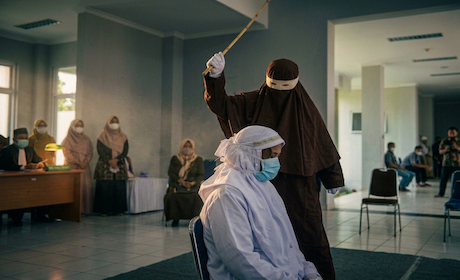
Sharia (literally “the path”) is not personal morality or optional “family law.” It is a comprehensive, divinely mandated legal, political, and social system designed to govern every aspect of human existence — from prayer and diet to crime, finance, warfare, and governance. There is no separation between religion and state.
Sources of Sharia
Sharia draws primarily from two texts:
- The Quran (roughly 10–15% of its content is explicitly legal).
- The Hadith and Sunnah (the vast majority of detailed rulings).
Scholars then apply ijma (consensus), qiyas (analogy), and other tools to derive fiqh (jurisprudence). In practice, the Hadith provide the bulk of everyday rules — which is why understanding them is essential.
Categories of of Islamic Law and Punishment
Islamic criminal law traditionally divides offenses into three (sometimes four) main categories:
- Hudud (“boundaries”/fixed punishments): Crimes against God with mandatory, unchangeable penalties. Examples:
- Theft → amputation of the hand (Quran 5:38).
- Unlawful sexual intercourse (zina) → 100 lashes (Quran 24:2) or stoning (via authentic Hadith).
- False accusation of zina → 80 lashes.
- Alcohol consumption → lashing.
- Highway robbery/apostasy → death or crucifixion in severe cases.
- Qisas (retaliation): “An eye for an eye” for murder or bodily harm. The victim’s family can demand execution, accept blood money (diyah), or forgive.
- Ta’zir (discretionary): All other offenses where the judge has flexibility (fines, imprisonment, flogging, etc.).
These are not ancient relics — they remain on the books and are applied in countries like Saudi Arabia, Iran, Afghanistan, and parts of Nigeria, Pakistan, and others.
No Separation of Mosque and State
Sharia makes no distinction between religious and civil authority. The state exists to enforce Allah’s law. Saudi Arabia’s Basic Law of Governance (its de facto constitution) states plainly:
“The constitution of the Kingdom of Saudi Arabia is the Book of God and the Sunnah of His Messenger.”
Governance is “based on justice, shura (consultation), and equality in accordance with Islamic Shari‘ah.”
The king must “supervise the implementation of Islamic Shari‘ah.” Similar principles apply wherever Sharia is the official legal source.
Under traditional Sharia, non-Muslims (as dhimmis) live as second-class subjects: they pay the jizya tax, face restrictions on public worship, and receive inferior legal status in court.
What Sharia Actually Governs
- Criminal justice (hudud punishments)
- Family law (marriage, divorce, inheritance, polygamy, wife discipline — Quran 4:34)
- Apostasy and blasphemy (death penalty in all major classical schools)
- Jihad and relations with non-Muslims
- Finance (ban on interest, zakat tax)
- Daily life (dress, diet, gender segregation, toilet etiquette)
Key Doctrines Sharia Enforces
- Apostasy and blasphemy: Death penalty in classical rulings (supported by Hadith).
- Jihad: Both spiritual (“greater jihad” against desires — a weak Hadith) and military (“lesser jihad” against non-believers — strongly attested in Sahih collections).
- Gender rules: Testimony, inheritance (half for females), guardianship, polygamy, and disciplining wives (Quran 4:34).
- Non-Muslims: Dhimmi status with jizya tax, restrictions on building places of worship, and legal inferiority in many rulings.
Contrast with the Sanitized Narrative
Western media and apologists often present Sharia as “personal ethics,” “family matters,” or something only devout Muslims choose. In reality, classical and orthodox Sharia is a complete sociopolitical system meant for the ummah (Muslim community) and, where possible, imposed on society at large. It is not “just for Muslims” in the sense of private belief — it regulates public order, speech, dress, finance, education, and relations with outsiders. This is why polls consistently show significant support among Muslims in many countries for making Sharia the law of the land, including hudud punishments. It is why demands for Sharia courts, blasphemy laws, and “no-go” areas keep appearing in the West. It’s not a misunderstanding. It’s the natural outworking of the doctrine which is not optional for individuals living in a Sharia-governed society — and which historically has never been content to remain private.
Bottom Line
Sharia is the practical application of the Quran and Hadith in real life. It transforms Islam from a religion into a complete civilizational operating system. Where it is fully enforced, personal freedom, religious liberty, and equality before the law (especially for women, ex-Muslims, and non-Muslims) are severely restricted by design.
Understanding Sharia is essential to understanding why Islamic doctrine so often clashes with modern liberal societies. It reveals why integration challenges, demands for parallel legal systems, and why clashes with Western liberal values are not misunderstandings — they are features, not bugs. This will become evident in upcoming chapters on Islam in the West and historical conquest.
While Theology I examined Allah’s view of Jesus and prior scriptures, this section tackles the bigger questions: What is the nature of God? Why are we here? Where are we headed? Islam’s answers differ sharply from those in Judaism and Christianity.
The Nature of Allah: A Distant, Sovereign Master
Islam presents Allah as utterly transcendent, all-powerful, and unknowable in any personal sense. He is not portrayed as a loving Father who desires relationship with His creatures. The Quran explicitly rejects the idea of God having a son or any familial bond:
“They say, ‘The Most Merciful has taken a son.’ You have done an outrageous thing.”
Quran 19:88-93
Allah’s love is conditional and collective — directed toward those who obey Him (Quran 3:31, 5:54). There is no concept of unconditional fatherly love or God pursuing sinners. He is frequently described as the best of planners, the deceiver (makir), and the one who leads astray whom He wills (Quran 14:4, 35:8, 76:30-31).
Fatalism (qadar) runs deep. Human destiny is decreed in advance, and Allah can choose to guide or misguide people as He pleases. This creates a fundamentally different relational dynamic: submission (‘Islam’ literally means submission/surrender) rather than intimate sonship or covenant love.
Additional contrasts:
- Allah speaks in the plural “We” yet fiercely denies the Trinity.
- Muslims are commanded to send blessings upon Muhammad in every prayer.
- There is no indwelling Holy Spirit, no new birth, and no assurance of salvation.
Yahweh of the Bible initiates relationship, offers grace, and sacrifices for His people. Allah demands total obedience and grants or withholds mercy according to His sovereign will.
The Purpose of Life
According to the Quran, the sole reason for human existence is clear:
“I did not create jinn and mankind except to worship Me.”
Quran 51:56
Humans are not described as being made in the image of God. They are servants (‘abd) created to submit. Life is a test of obedience, and success is measured by adherence to the Five Pillars and Sharia.
The Afterlife: Jannah and Jahannam
Islam’s vision of eternity is highly physical and transactional.
Paradise (Jannah) is depicted as a luxurious garden with:
- Rivers of wine that doesn’t intoxicate
- Endless fruits and meats
- Silk garments and palaces
- Houris — wide-eyed virgins created for the pleasure of male believers (Quran 55:56-58, 56:22-24, 78:33)
Multiple authentic Hadiths describe explicit sexual rewards: believers receive eternal erections, no fatigue, and up to 72 houris each, plus their earthly wives if they qualify. This raises an obvious theological tension: if the afterlife is purely spiritual, why such an obsessive focus on carnal, earthly pleasures? If it is physical, it implies resurrected bodies with functioning genitals and hormones forever engaged in sex. Either way, Jannah sounds less like eternal communion with God and more like an eternal 7th-century Arabian luxury resort.
Hell (Jahannam) is equally graphic and mostly eternal. Disbelievers and many Muslims will have their skin repeatedly burned off and replaced so they can suffer again (Quran 4:56). The Quran repeatedly warns that most people will end up there.
Crucially, there is no assurance of salvation. Even Muhammad reportedly said he did not know what would happen to him (Quran 46:9). Salvation depends on works, fighting in Allah’s cause, and hoping for arbitrary divine mercy.
Pagan Continuities and Historical Spread
Many Islamic rituals retain clear pre-Islamic pagan elements:
- The Kaaba in Mecca was a pre-Islamic pagan shrine housing multiple idols. Muhammad destroyed the idols but kept the structure and the Black Stone (a meteorite venerated by pagan Arabs).
- Circling the Kaaba, kissing the Black Stone, and many Hajj rites were pagan practices that Islam retained and rebranded.
- Muhammad initially prayed toward Jerusalem to appeal to Jews. When they rejected him, he changed the qibla to the Kaaba and later claimed Abraham and Ishmael built it — a claim with zero support in Jewish or Christian scripture or archaeology.
- The lunar calendar, crescent moon symbolism, and many Hajj rites.
These pagan elements were “Islamized” rather than abolished, showing strong continuity with the Arabian religious environment Muhammad grew up in.
Historically, Islam did not primarily spread through peaceful, voluntary conversion. It expanded rapidly through military conquest, followed by high birth rates and social pressure on conquered populations. This contrasts with early Christianity, which grew despite persecution.
Contrast with the Sanitized Narrative
Many modern presentations claim Islam is just another Abrahamic faith with the same loving God. In reality, the theological gap is wide: no grace, no savior, no indwelling Spirit, no certain hope of heaven, and a fundamentally different view of God’s character. What Christianity offers as relationship, Islam offers as transaction — obedience in exchange for possible reward.
Bottom Line
Islam’s theology centers on absolute submission to a distant, sovereign Allah whose mercy is unpredictable. Life’s purpose is worship and obedience. The afterlife is a sensual reward for the faithful and horrific punishment for others — with no guaranteed ticket for anyone. This framework produces a works-based, fear-infused religion that prioritizes law and power over redemption and love.
Understanding these theological realities helps explain both the devotion of believers and the persistent tensions with cultures built on different foundations.
Islam presents itself as the final and perfected Abrahamic faith — the one that “confirms” Judaism and Christianity while completing them. Official dawah often claims respect for “People of the Book.” But when you examine the primary sources, history, and theology, a very different picture emerges: Islam views itself as supreme, with all other religions ultimately required to submit.
Theological Claims vs. Reality
The Quran repeatedly claims to confirm the Torah and Gospel:
He has revealed to you ˹O Prophet˹ the Book in truth, confirming what came before it, as He revealed the Torah and the Gospel.
Quran 3:3; see also 5:46-47, 10:94
Yet it directly contradicts them on the doctrines Christians and Jews consider essential. It denies the crucifixion (4:157), rejects Jesus as the Son of God, misrepresents the Trinity (often as Mary + Jesus + God in 5:116), and insists no one can bear another’s sins. As Lee Strobel and others have noted, these are precisely the elements required for Christian salvation.
The result is the Islamic Dilemma: If the earlier scriptures were corrupted, why does the Quran repeatedly affirm them as guidance still available in Muhammad’s time? If they were reliable, why the contradictions? Abrogation and claims of tahrif (corruption) are used to resolve this tension, but they leave prior faiths in a permanently subordinate position.
Quran 3:85 is blunt:
Whoever vseeks a religion other than Islam, it will never be accepted from him, and he will be among the losers in the Hereafter.
Treatment of Jews and Christians
- Jews: The Quran accuses them of distorting scripture (2:75, 4:46), calls them apes and pigs in some passages (2:65, 5:60), and records Muhammad’s conflict with the Jewish tribes of Medina. The most notorious incident is the Banu Qurayza massacre in 627 CE: after surrender, 600–900 men and boys were beheaded in one night, with women and children taken as slaves. This is detailed in classical sources including Ibn Ishaq, al-Tabari, and Hadith collections.
- Christians: Initially more positive in weak Meccan verses, the tone hardens in Medina. Christians are to be fought until they pay the jizya “while they are humbled” (9:29). The Quran denies core Christian beliefs and, in some verses, places them among the worst of creatures when they associate partners with Allah (98:6).
Under classical Sharia, both groups could live as dhimmis — protected but second-class subjects required to pay tribute, accept restrictions on worship and public life, and remain subordinate.
Spiritual and Theological Comparison
Islam’s approach to other faiths flows from its theology. Here is how its spirituality and view of God compare to Christianity:
Christian mysticism seeks transformative intimacy with a God who pursues relationship. Islamic ritual emphasizes disciplined obedience to a distant Allah whose mercy is never guaranteed.
Historical Pattern
Islam’s early expansion was overwhelmingly military. Between the 7th and 20th centuries, it grew primarily through conquest, not voluntary conversion. Today, in many Muslim-majority countries, criticism of Islam or apostasy remains punishable by law, while Western societies are expected to accommodate Islamic practices. There is little reciprocity.
Some observers note striking parallels between the biblical Antichrist figure and the Islamic Mahdi/Isa narrative (uniting the world under one system, conquering Jerusalem, enforcing submission, false signs and wonders). Whether literal or not, the pattern of dominance is clear in the texts themselves.
Bottom Line
Islam does not “play well” with other religions in the modern pluralistic sense. It offers a clear hierarchy: Islam at the top, other Abrahamic faiths tolerated only under submission (dhimmitude), and polytheists/idolaters given fewer options. This is not a cultural accident — it flows directly from the Quran, Hadith, Muhammad’s example, and 1,400 years of history.
The claim of being the final, tolerant Abrahamic faith collapses under scrutiny. What begins as “confirmation” ends as replacement and supremacy. Understanding this external posture is essential to grasping why Islam functions as both religion and political ideology.
This concludes the foundational “Islam 101” section. The rest of the site builds on these doctrinal realities.